





Can you trust a URL shortener?
Nearly every URL shortener says its links are safe. Saying so costs nothing, so the claim alone tells you little. What a service really does about harmful links shows up in a place anyone can look: the verdicts security vendors give its own address. Here is how to run that check, what it showed for one service that advertises virus-free shortening, and what it showed for nev.lt.How the check works
Use a public scanner. VirusTotal gathers the verdicts of about ninety security vendors for any address. Enter the address of the shortener itself, not one of its links. Read the result with care. A flag means that a vendor connected the address with phishing or malware when it looked. With a shortener this usually happens because harmful links made by its users stayed online. One or two flags can be a mistake. A long list is a pattern. Why it matters to you. Browsers, mail filters, and antivirus programs rely on these vendors. If they distrust a shortener, a link you made there can be blocked or marked as dangerous, wherever it leads.One example: the promise and the result
The promise. In a security guide on its site, under the heading “How URLVanish Ensures Safe, Virus-Free URL Shortening”, URLVanish states: “Every URL submitted to URLVanish is checked against multiple threat intelligence feeds and malware databases.” The result. On 6 October 2026 at 14:30 UTC, VirusTotal showed 14 of 93 security vendors flagging urlvanish.com as phishing, malware, or malicious. This does not prove that the service was built to harm anyone, and the result may be different on the day you read this. It does show that on that day the promise on the page and the view of security vendors did not match. Run the check yourself before you rely on any figure, ours included.The same check for nev.lt
The result. On 7 October 2026 at 11:21 UTC, none of the 93 security vendors listed by VirusTotal flagged nev.lt. What is behind it. Every link is screened when it is created and checked again while it is in use. Suspicious links show a warning first, and harmful ones are removed. Our guide to short link safety describes each step. No service can promise that this number stays at zero: vendors make mistakes, and new threats appear every day. Check nev.lt yourself whenever you like.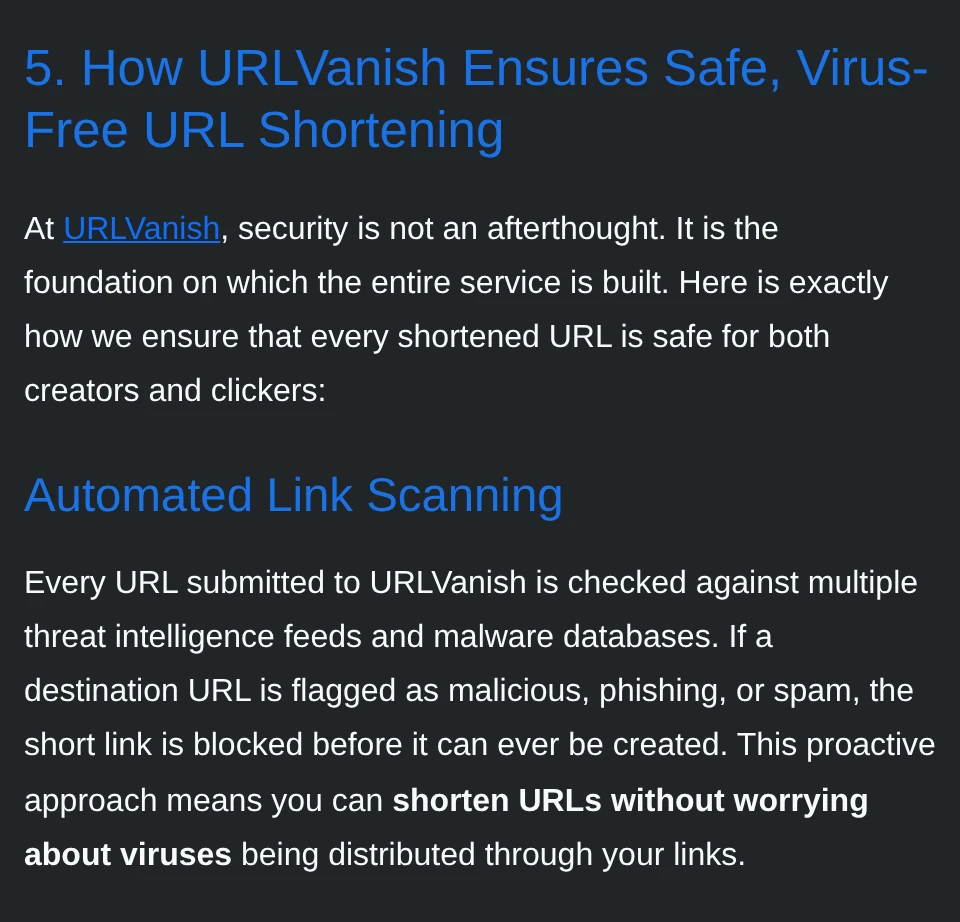
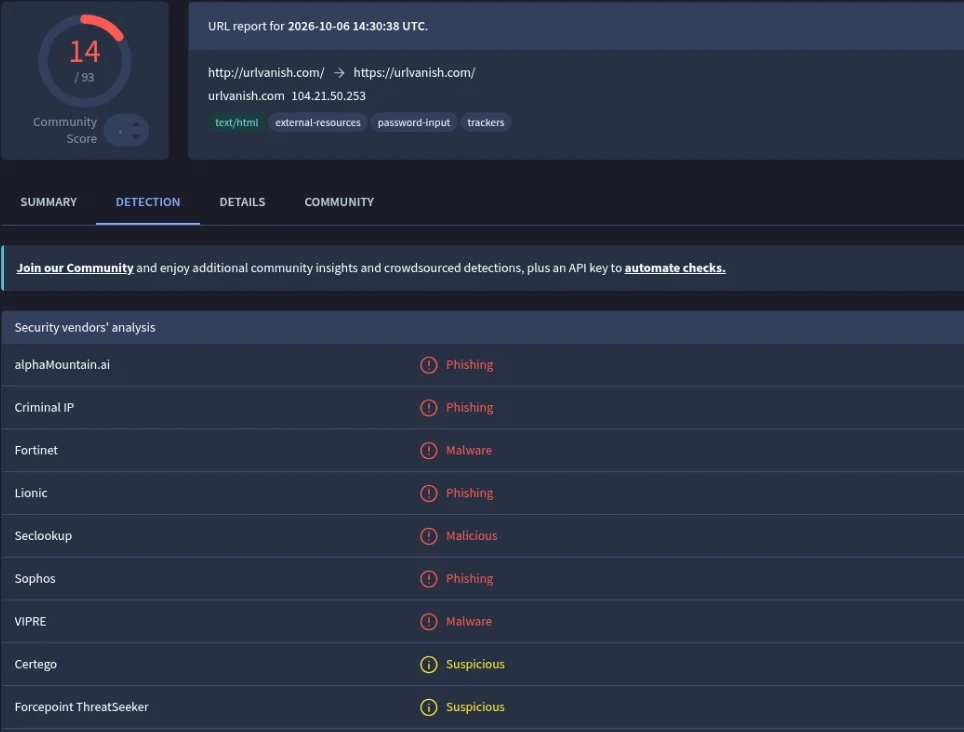
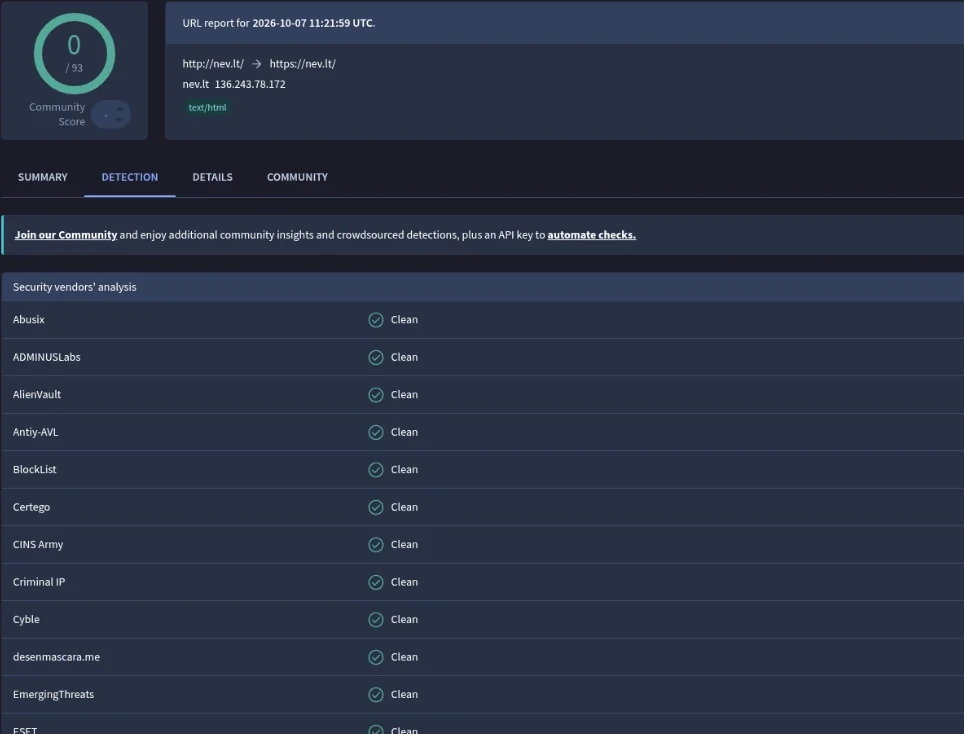
Screenshots: the guide on urlvanish.com as it appeared on 7 October 2026, the VirusTotal report for urlvanish.com of 6 October 2026, and the VirusTotal report for nev.lt of 7 October 2026.
Before you choose a shortener
Check its address. It takes a minute and costs nothing. Read how it handles harmful links. A service you can trust says how it screens links and how to report one. Compare what you get for free. Our comparison of free URL shorteners puts limits, statistics, and QR codes side by side.Frequently Asked Questions
How do I check whether a URL shortener is safe?
Enter the address of the shortener itself into a public scanner such as VirusTotal and see how many security vendors flag it. Then read how the service screens links and how it handles reports.
Why would a URL shortener be flagged by security vendors?
Usually because harmful links created by its users stayed online long enough for vendors to notice. The vendors then distrust the whole address, not only the harmful links.
Does a flagged shortener affect my own links?
It can. Browsers, mail filters, and antivirus programs that rely on those vendors may block or warn about any link from that address, harmless ones included.
Is nev.lt flagged by security vendors?
On 7 October 2026 none of the 93 security vendors listed by VirusTotal flagged nev.lt. Results change over time, so look up the current one yourself.